Every refrigeration and air conditioning system commissioned in India today will likely still be running in 2040. The refrigerant choices made now — in OEM product lines, in new commercial installations, in procurement decisions — will determine whether those systems remain compliant, available to service, and aligned with regulations that are already in motion.
The Kigali Amendment has set India’s HFC phase-down on a defined schedule. The EU and US have already moved: refrigerants with a GWP above 700 are banned from new HVAC equipment in the US as of January 2025. India’s baseline freeze follows in 2028. The direction is clear. What remains less clear, for many professionals, is which low-GWP refrigerants actually work — and for which applications.
This guide answers that question with specific numbers, not marketing language.
Key takeaways
GWP (Global Warming Potential) measures how much heat a refrigerant traps in the atmosphere relative to CO₂ over 100 years. A lower GWP means a smaller climate impact if the refrigerant is released.
Not every low-GWP refrigerant suits every application. Selection depends on GWP, flammability class, system capacity, charge limits, and what the OEM’s equipment is designed for.
The main low-GWP options fall into three families: natural refrigerants (R-290, R-744, R-717), HFOs (R-1234yf, R-1234ze), and HFO/HFC blends (R-32, R-454B).
India’s Kigali phase-down schedule runs from 2028 to 2047. Procurement decisions made today on systems with 15 to 20-year lifespans must account for which refrigerants will still be available and compliant in 2035 and beyond.
The climate benefit of switching to a low-GWP refrigerant is only fully realised when the refrigerant is batch-tested, genuine, and correctly charged. An adulterated or contaminated product at any GWP level is not a responsible choice.
What is GWP in refrigeration — and why does the number matter?
GWP — Global Warming Potential — is a measure of how much heat a gas traps in the atmosphere relative to CO₂ over a 100-year period. CO₂ itself has a GWP of 1. A refrigerant with a GWP of 2,000 means one kilogram of that refrigerant, if released into the atmosphere, has the same warming effect as two tonnes of CO₂.
In refrigeration, GWP matters for two reasons.
The first is regulatory. Global agreements under the Montreal Protocol — and specifically the Kigali Amendment — are designed to phase down high-GWP HFC refrigerants. Governments set timelines and quotas; manufacturers and importers face restrictions; professionals specifying equipment and refrigerants need to work within those frameworks.
The second is operational. Refrigerant leaks happen — through wear, faulty joints, poor installation, or inadequate maintenance. In a high-GWP system, every kilogram that escapes carries a significant climate cost. In a low-GWP system, that same leak carries a fraction of the impact.
Understanding GWP is therefore not an academic exercise. It is a procurement and specification tool.
How refrigerants are classified by GWP
The refrigerant market divides broadly into three GWP tiers, which also map onto the major chemical families.
High-GWP HFCs (GWP 1,000 and above): These are the dominant refrigerants of the past three decades — R-22, R-410A, R-404A, R-134a. They are efficient and well-understood, but they carry significant climate impact per kilogram and are now subject to phased reduction under the Kigali Amendment.
Mid-GWP transitional refrigerants (GWP 150–750): This tier includes R-32 (GWP 675) and HFO-blend refrigerants like R-454B (GWP approximately 466). They are the primary transition pathway for air conditioning and heat pump applications that cannot yet use natural refrigerants.
Ultra-low-GWP refrigerants (GWP below 10): This includes natural refrigerants — R-290/propane (GWP 3), R-744/CO₂ (GWP 1), R-717/ammonia (GWP approximately 0) — and HFOs like R-1234yf (GWP less than 1). These carry the smallest climate footprint but come with their own handling requirements.
Low-GWP refrigerant options: a verified comparison
The table below covers the refrigerants most relevant to Indian commercial and industrial refrigeration today, ranked by GWP. All GWP values are based on the IPCC AR5 100-year assessment, which is the current regulatory reference.
This table is a working reference, not a selection guide on its own. The right refrigerant for a given system depends on the factors covered in the next section.
Which low-GWP refrigerant suits which application?
Choosing between low-GWP refrigerant options is not a single decision. It is a set of decisions based on system type, capacity, environment, and the OEM’s equipment specifications. Here is how the main options map to real applications.
R-32 — the default transition refrigerant for air conditioning
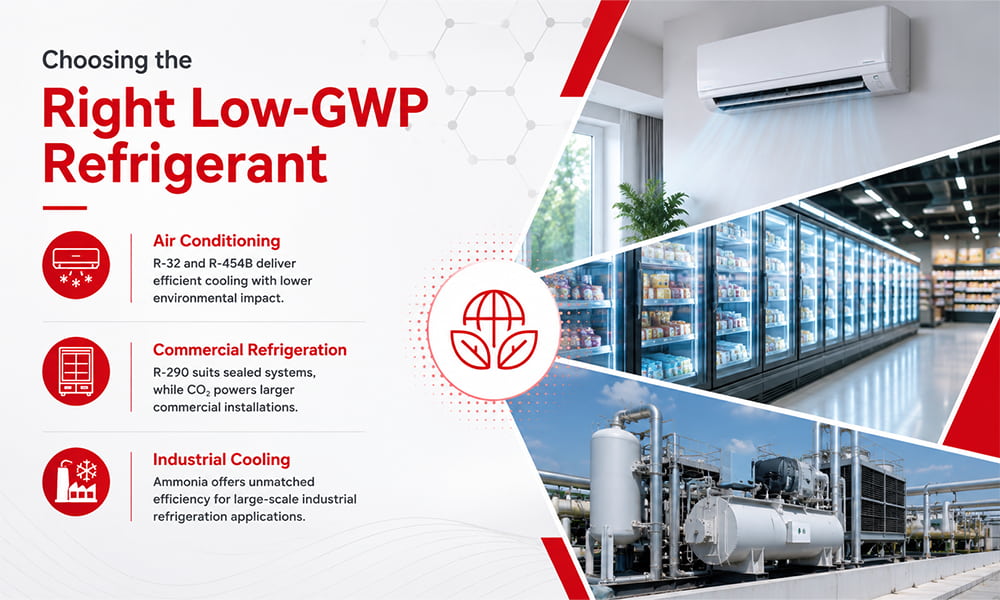
R-32 is the most widely deployed low-GWP refrigerant in new HVAC equipment globally as of 2026. With a GWP of 675 — roughly 68% lower than R-410A — and strong energy performance, it is the direction most major OEMs have taken for residential and light commercial split systems, multi-split, and VRF equipment.
R-32 is classified A2L (mildly flammable), which requires equipment designed for A2L refrigerants and trained installers. In India, where R-32 adoption has been steady since the mid-2010s, this training infrastructure is well established.
For most HVAC contractors and facility managers working with split AC systems or VRF equipment, R-32 is the practical answer to the question of which low-GWP refrigerant to specify today.
R-290 — the right choice for small, sealed commercial systems
R-290 (propane) has a GWP of 3 — effectively negligible for climate purposes. Its energy efficiency is 10 to 20% better than R-134a in comparable systems (GIZ Proklima, 2025). These numbers make it compelling.
The constraint is flammability. R-290 is A3 — highly flammable — and most applicable safety standards restrict its charge to 150 grams or less per circuit in occupied spaces. This limits R-290 to factory-sealed, small-capacity applications: bottle coolers, ice cream display cases, vending units, small split ACs, and heat pumps designed specifically for the refrigerant.
For applications within this envelope, R-290 is one of the most responsible refrigerant choices available. For larger-capacity or open-system applications, it is not currently appropriate.
R-454B — the lower-GWP alternative to R-410A for commercial systems
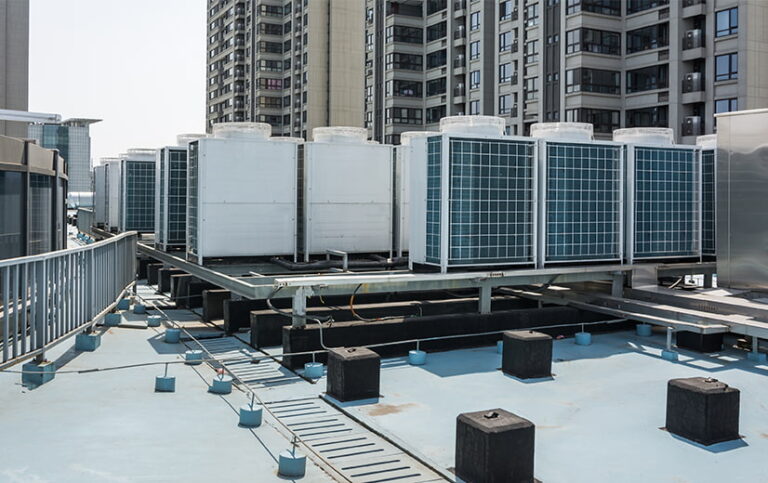
R-454B is a blend of R-32 and R-1234yf, with a GWP of approximately 466. It was developed specifically to replace R-410A in systems where R-32 alone is not a direct fit. It is A2L-classified and is increasingly used in larger-capacity light commercial AC, heat pumps, and condensing units.
In the US, R-454B has become one of two dominant A2L refrigerants (alongside R-32) for new equipment, accounting for a significant share of ducted unitary equipment sales in 2025. India’s OEM landscape is beginning to adopt it as well, particularly for systems that need to stay within the GWP thresholds being set by emerging procurement standards.
R-744 (CO₂) — for industrial scale and cascade systems
CO₂ has a GWP of 1. In transcritical and cascade configurations, it is well suited to large-scale commercial refrigeration, industrial cold storage, and supermarket systems. Its A1 classification (non-flammable, non-toxic) removes the handling complexity of ammonia while still achieving a near-zero GWP.
The trade-off is operating pressure: CO₂ systems run at significantly higher pressures than HFC systems, which requires purpose-built equipment and trained engineers. For large-scale applications where those requirements are manageable, CO₂ is a technically proven, regulatory-proof choice.
R-717 (Ammonia) — for large industrial refrigeration
Ammonia has been used in industrial refrigeration since the 1870s. Its GWP is effectively zero. Its energy efficiency is unmatched for large-capacity systems. The challenge is toxicity — its B2L classification requires strict safety protocols, dedicated machinery rooms, leak detection systems, and trained personnel.
For food processing facilities, large cold storage warehouses, dairy plants, and breweries, ammonia remains the most capable and lowest-impact natural refrigerant available. Its operating infrastructure in India is well established in the industrial sector.
India’s low-GWP refrigerant transition: where the market is headinga
India’s Kigali phase-down trajectory is now clearly defined. Having ratified the amendment in September 2021, India has committed to:
Freezing HFC consumption at the 2024–2026 average baseline by 2028
A 10% reduction from that baseline by 2032
A 20% reduction by 2037
An 85% reduction by 2047
The NRDC India HFC Phase-Down Pathways report (December 2025) analyses India’s sector-by-sector transition pathway and identifies the AC sector as the largest consumer of HFCs, with R-410A the dominant refrigerant in the installed base. The practical implication: the AC sector faces the largest volume of transition activity, and the shift to R-32 (and R-454B in larger-capacity equipment) is the primary near-term pathway.
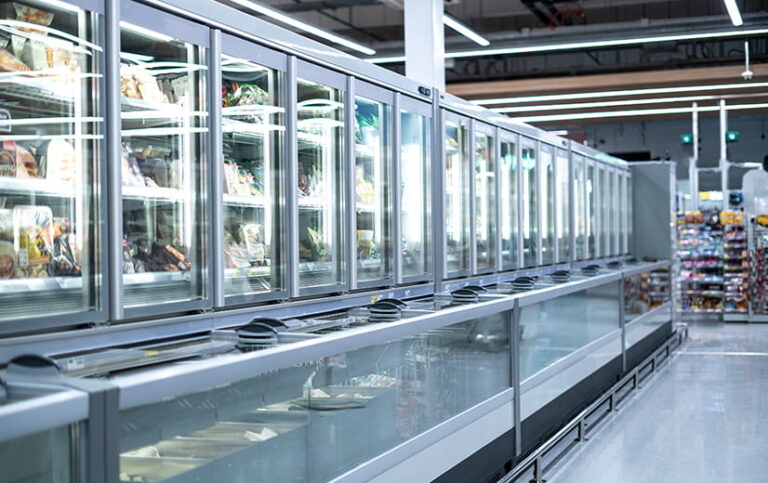
For the commercial cold chain sector — cold storage, transport refrigeration, supermarkets — the transition is more varied. R-404A systems are moving toward R-448A, R-449A, and CO₂ alternatives. The pharmaceutical cold chain is evaluating R-290 and CO₂ for new investments.
India’s Bureau of Energy Efficiency (BEE) star rating programme is already influencing refrigerant selection: energy-efficient A2L and natural refrigerant systems score better in star ratings, creating a commercial incentive that runs alongside the regulatory mandate.
For distributors and procurement teams: the low-GWP refrigerants that will matter most for India’s market over the next decade are R-32, R-290, R-454B, and CO₂ — in different segments and at different scales. Building sourcing capability in these refrigerants now, before peak transition demand, is the responsible commercial position.
The quality dimension: why GWP on the label is not enough
Most discussions of low-GWP refrigerants focus entirely on the chemistry. The GWP value. The regulatory timeline. The safety classification. What they rarely address is the quality of what is actually in the cylinder.
This matters more than it is usually acknowledged.
The climate benefit of switching from R-410A (GWP 2,088) to R-32 (GWP 675) is real — but it is only realised when the refrigerant in the system is genuinely R-32, batch-tested to AHRI 700 purity standards, correctly charged, and not leaking due to a contaminated charge degrading compressor seals or causing system failure.
Adulterated or off-spec refrigerant — the kind that cannot be verified at the point of use — negates the environmental argument. A system charged with contaminated product suffers more failures, leaks more refrigerant over its life, and may require unplanned replacements that generate their own environmental cost.
AHRI 700 sets the international purity standard for refrigerants: maximum allowable limits for moisture, acidity, non-condensables, and other contaminants. Batch-tested, QR-verified refrigerant — where every cylinder links to its specific quality record — is what a genuinely responsible refrigeration system deserves.
Choosing a low-GWP refrigerant is a meaningful decision. Verifying that the refrigerant in the cylinder matches that decision is the step that makes it count.
Genuine Refrigerants.
FAQ
What does GWP mean in refrigeration? GWP stands for Global Warming Potential — a measure of how much heat a refrigerant gas traps in the atmosphere relative to CO₂ over 100 years. A refrigerant with a GWP of 2,000 has 2,000 times the warming effect of CO₂ per kilogram released. In refrigeration, GWP is the key metric for comparing the climate impact of different refrigerant choices and for understanding regulatory requirements under the Kigali Amendment.
Which refrigerant has the lowest GWP? Among refrigerants in common use, ammonia (R-717) has a GWP of approximately 0, CO₂ (R-744) has a GWP of 1, and propane R-290 has a GWP of 3. HFOs such as R-1234yf and R-1234ze(E) also have GWPs below 1. Among the transitional A2L refrigerants, R-454B has a GWP of approximately 466 and R-32 has a GWP of 675 — both significantly lower than R-410A (GWP 2,088) and R-22 (GWP approximately 1,810).
Are HFO refrigerants a good alternative to HFCs? HFO (Hydrofluoroolefin) refrigerants — including R-1234yf and R-1234ze — offer GWPs below 1 and are already used in automotive air conditioning and large commercial chillers. HFO-based blends like R-454B extend this chemistry into broader HVAC applications. HFOs represent a meaningful step down from HFCs in climate terms, though they are currently more expensive than HFC alternatives and rely on chemical patents held by a small number of manufacturers.
What is the difference between low-GWP and zero-ODP refrigerants? GWP (Global Warming Potential) measures a refrigerant’s contribution to climate change. ODP (Ozone Depletion Potential) measures its contribution to ozone layer destruction. R-22, an older HCFC refrigerant, has both high GWP and non-zero ODP — it causes ozone depletion and has a significant climate impact. Most modern HFC and HFO refrigerants have zero ODP but vary widely in GWP. A refrigerant can be zero ODP but still carry a high GWP (such as R-410A at 2,088), which is why both values matter when evaluating a refrigerant.
How does India’s Kigali Amendment commitment affect refrigerant procurement? India has committed to freezing its HFC consumption baseline by 2028 and reducing it by 10% from 2032, reaching an 85% reduction by 2047. This means refrigerant-intensive sectors — particularly air conditioning, commercial refrigeration, and cold chain — will face increasing regulatory pressure on high-GWP HFCs. Procurement decisions being made today on equipment with a 15 to 20-year lifespan should prioritise refrigerants below GWP 750, which are less likely to face phase-down restrictions during that equipment’s operational life.
Why does refrigerant purity matter for sustainability? A low-GWP refrigerant only delivers its environmental benefit when it is genuine, correctly charged, and not leaking due to system damage caused by impurities. Contaminated refrigerant — containing moisture, non-condensables, or off-spec blends — degrades compressor performance, increases leak rates, and shortens system life. AHRI 700-compliant, batch-tested, QR-verified refrigerant ensures the quality record matches the environmental claim. Sustainability in refrigeration is a system-level commitment, not a label on a cylinder.
Conclusion
Low-GWP refrigerants are not a future consideration for India’s cooling industry. They are a present reality — in OEM product lines, in regulatory timelines, and in the procurement decisions being made right now for equipment that will be in service through the 2040s.
The choice between R-32, R-290, R-454B, CO₂, and ammonia is not a single answer. It is a set of answers shaped by application, system capacity, safety infrastructure, and OEM compatibility. What all of those choices have in common: the refrigerant inside the cylinder must be what the label says it is — batch-tested, AHRI 700-compliant, and QR-verified at the point of use.
A verified low-GWP refrigerant is a genuinely responsible choice. An unverified one is an assumption.
Genuine Refrigerants.
Ready to source batch-tested, AHRI 700-compliant low-GWP refrigerants for your next project? Explore our refrigerant range or talk to our technical team about the right refrigerant for your application and transition planning.