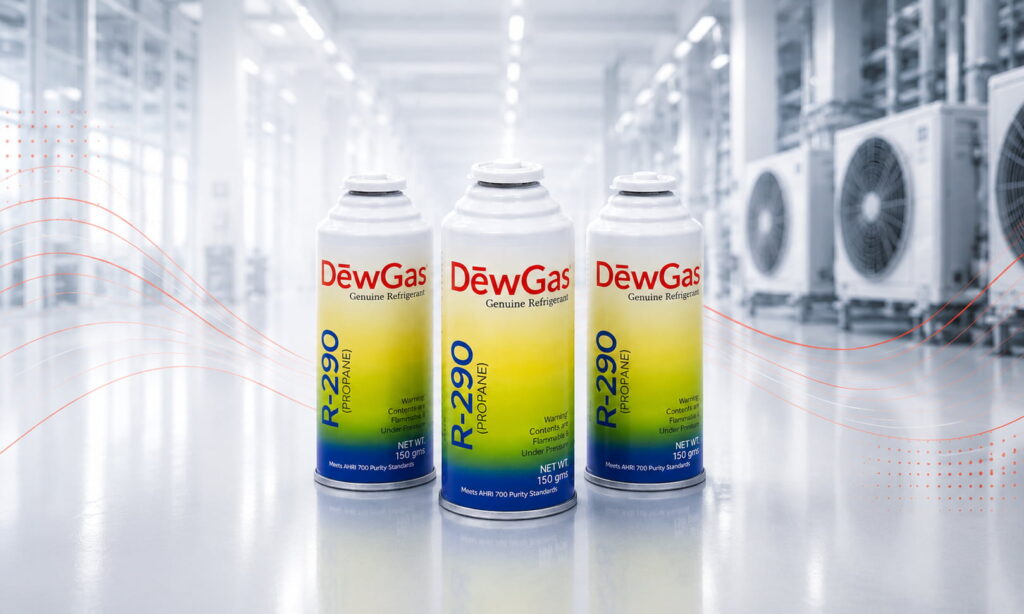
India’s cooling industry is in the middle of a structural shift. High-GWP HFCs like R-410A and R-404A are on a phased reduction path under the Kigali Amendment. OEMs are redesigning product lines. Contractors are recalibrating what they specify. And one refrigerant is appearing more frequently in conversations about what comes next: R290.
R290 refrigerant gas is not a new molecule. It has been used in commercial refrigeration for decades. What is new is the scale of its adoption — and the urgency behind it. If you work in HVAC, commercial cooling, or refrigeration supply, understanding what R290 actually is, where it works, and how it must be handled is no longer optional.
Key takeaways
R290 is propane (C₃H₈) — a naturally occurring hydrocarbon refrigerant with a GWP of just 3, making it one of the lowest-impact refrigerants available.
It is zero ODP, highly energy-efficient, and genuinely compatible with the direction India’s refrigerant regulations are heading.
R290 is classified A3 under ASHRAE Standard 34 — low toxicity, but highly flammable. Correct handling, system design, and leak detection are non-negotiable.
Charge limits apply: most applications are restricted to 150g or less per circuit, which makes R290 best suited to small-to-medium systems.
Refrigerant-grade R290 and industrial propane are not the same product. What is in the cylinder matters as much as the label on it.
What is R290 refrigerant gas?
R290 refrigerant gas is pure propane — chemical formula C₃H₈ — used as a working fluid in refrigeration and air conditioning systems. It is classified as a natural refrigerant because it occurs in nature, is not manufactured through industrial chemical synthesis, and carries none of the ozone-depleting chlorine atoms found in older HCFCs like R-22.
As a refrigerant, R290 operates on the same vapour-compression cycle as any other refrigerant gas: it evaporates at low pressure to absorb heat, is compressed to raise its temperature, condenses to release that heat, and expands to reset the cycle. What makes R290 distinctive is what it does at each stage — and what it leaves behind in the atmosphere if it ever escapes.
R290 is part of the HC (hydrocarbon) family of refrigerants, alongside R600a (isobutane), which is commonly used in domestic refrigerators. Both are considered among the most environmentally responsible refrigerant options available today, and both are gaining ground globally as the HFC phase-down accelerates.
The environmental case for R290
The numbers here are significant enough to state plainly.
R290 has a GWP of 3. Compare that to R-410A at 2,088, R-22 at approximately 1,810, R-134a at 1,430, and R-404A at approximately 3,922. That means, per kilogram released, R290 has roughly 700 times less climate impact than R-410A.
Its ODP is zero. Unlike R-22, R290 contains no chlorine and causes no ozone depletion.
It is also naturally abundant. Propane is a by-product of natural gas processing and petroleum refining. It does not require complex industrial synthesis, and its availability is not dependent on the kind of patent-protected supply chains that govern HFO refrigerants.
For a market navigating the Kigali Amendment — with India’s HFC consumption baseline set to freeze in 2028, and reductions beginning in 2032 — R290 is one of the very few options that faces no further phase-down pressure. It is already at the GWP floor.
The performance case for R290
Low environmental impact is compelling. But performance is what drives adoption in the field.
R290 consistently demonstrates 10 to 20% better energy efficiency than R-134a and R-22 in comparable systems (GIZ Proklima, 2025). Its high latent heat of vaporisation means it can transfer more heat per kilogram of refrigerant — which translates into better cooling capacity for a given compressor size.
It also has excellent thermodynamic properties across a wide temperature range. Evaporation and condensation pressures for R290 are well suited to both air conditioning and medium-temperature commercial refrigeration, without requiring the extreme high-side pressures that some HFC alternatives demand.
Lower charge mass is another practical advantage. Because R290 is more thermodynamically effective per kilogram than many HFCs, systems typically require a smaller refrigerant charge to achieve the same cooling output. Smaller charge mass means lower material cost per unit and reduced emissions risk if a leak occurs.
These performance characteristics explain why major Indian OEMs, including Godrej, have moved R290 into their product lines. China and India together now produce approximately 15.3 million R290 split AC units per year (GIZ Proklima, 2025) — a figure that reflects industrial confidence in the refrigerant’s real-world viability.
Where R290 is used
R290 refrigerant gas is currently used across four main application areas.
Split air conditioners and heat pumps. This is where R290’s growth in India is most visible. The combination of low GWP, zero ODP, and strong energy efficiency makes R290 an increasingly common choice for residential and light commercial split AC systems. India’s leading R290 AC model has sold over 600,000 units safely to date (GIZ Proklima, 2025).
Commercial refrigeration — stand-alone units. Bottle coolers, ice cream display freezers, vending units, and self-contained display cases are all established applications for R290. These units are factory-sealed, use small charge masses, and are designed specifically to contain flammable refrigerant safely.
Small walk-in coolers and cold rooms. R290 is used in smaller-footprint cold storage applications where the charge mass stays within the limits set by safety standards and where the installation environment can be adequately ventilated.
Heat pumps and dehumidifiers. R290’s thermodynamic properties make it well-suited to heat pump applications where both heating and cooling efficiency matter.
Where R290 is not typically used: large-capacity central systems, high-charge industrial refrigeration equipment, and applications where the required refrigerant charge would exceed safe limits for an A3 refrigerant. For those applications, ammonia (R-717) or CO₂ (R-744) remain the more practical natural refrigerant choices.
Safety: what every technician needs to know
R290’s flammability is not a reason to avoid it — it is a reason to handle it correctly. The safety profile of R290 is well understood, and systems designed for it are safe when properly installed and maintained. What is not acceptable is treating it the same as an HFC.
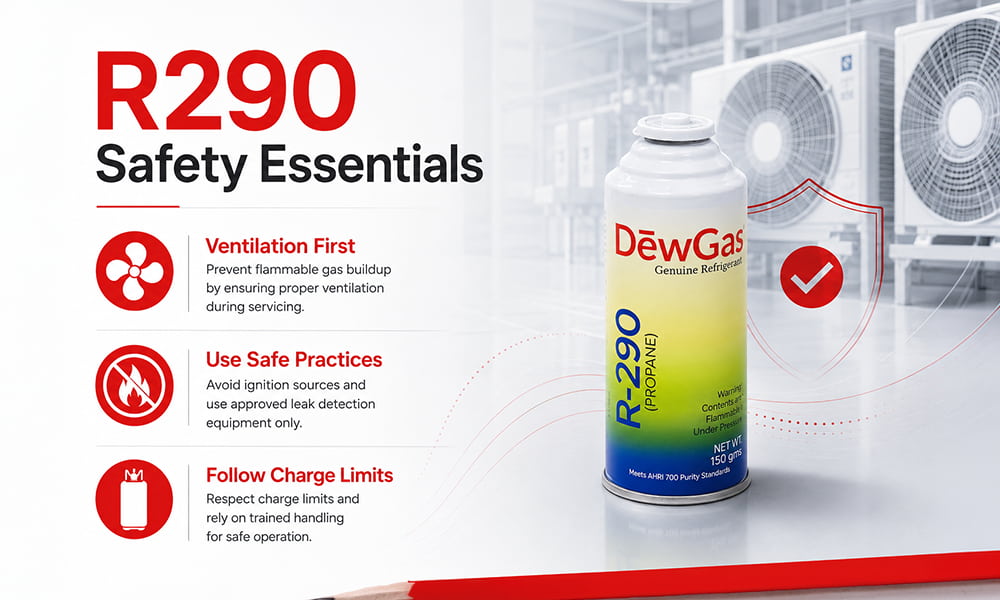
Flammability range. R290 ignites when its concentration in air falls between 2.1% and 9.5%. Below that range, there is not enough fuel to burn; above it, there is not enough oxygen. The practical implication: even a small leak in an unventilated space can create a flammable atmosphere. Ventilation is not optional.
R290 is heavier than air. Unlike methane, which rises, propane settles at low points — floor level, cabinet bases, drains. When you are assessing a space for a potential R290 leak, check low areas first.
Leak detection. R290 is odourless in its refrigerant-grade form. You cannot rely on smell. Use an electronic combustible-gas detector rated for flammable refrigerants. Do not use a halide torch or any open-flame detection method. Soap solution is acceptable for localised leak testing.
Ignition sources. No open flames, sparks, or unswitched electrical equipment near an R290 system during service. Isolate power before opening any refrigerant circuit. Use only tools and equipment rated for use with flammable refrigerants.
Charge limits. Most applicable safety standards, including IEC 60335-2-89, restrict the charge mass per refrigerant circuit. For occupied spaces, this is typically 150g or less. Systems are engineered around this limit — do not top up beyond the manufacturer’s specified charge.
Training matters. If you have not worked with A3 refrigerants before, training is the right starting point — not experimentation. The gas itself is forgiving within a well-designed system; the risk arises when handling shortcuts are taken outside that system.
R290 in India: the transition in progress
India is a significant and growing R290 market. The country’s HCFC phase-out under the Montreal Protocol has already moved most of the sector away from R-22. The next question — which refrigerant comes next — is increasingly being answered with R290 for small-to-medium cooling equipment, and R-32 for larger-capacity systems.
The GIZ Proklima R290 Split Air Conditioners Resource Guide (updated April 2025) tracks India’s growing production capacity and confirms that the infrastructure, OEM capability, and servicing knowledge base for R290 are all developing rapidly. Godrej and other Indian manufacturers have invested in R290 product lines. The Bureau of Energy Efficiency (BEE) star rating programme rewards energy-efficient refrigerants, and R290 systems are benefiting from that positioning.
What this means for contractors and distributors: R290 equipment is arriving in the Indian market at scale. The time to build handling knowledge and source a reliable supply of refrigerant-grade R290 is now — before that demand peaks.
Why refrigerant-grade R290 matters: not all propane is the same
This is a point that most articles about R290 do not address directly — and it is one of the most important things a professional buyer needs to understand.
R290 used in refrigeration systems must be refrigerant-grade propane. Industrial propane, LPG, and fuel-grade propane are not the same product. They are produced to different purity standards and may contain impurities — including moisture, sulphur compounds, heavier hydrocarbons, and other contaminants — that are unacceptable inside a sealed refrigeration circuit.
Moisture contamination in an R290 system causes the same corrosive acid formation as in any other refrigerant circuit. Non-condensable gases affect system pressure, efficiency, and diagnostic accuracy. Off-spec product can make a well-designed R290 system perform like a poorly charged one.
Refrigerant-grade R290 is manufactured and handled to specifications that exclude these contaminants. AHRI 700 is the international purity benchmark: it sets maximum allowable limits for moisture, acidity, non-condensables, and other impurities. Batch-tested, AHRI 700-compliant R290 — with a QR-linked quality record on every cylinder — is what a professionally installed R290 system deserves.
The cylinder matters. Scan it before you charge.
FAQ
What is R290 refrigerant gas? R290 is refrigerant-grade propane (C₃H₈), a naturally occurring hydrocarbon used as a working fluid in refrigeration and air conditioning systems. It has a GWP of 3 and zero ODP, making it one of the most environmentally responsible refrigerant gases available. It is classified A3 by ASHRAE Standard 34, meaning low toxicity and high flammability.
What is the difference between R290 gas and natural gas? R290 is propane — a three-carbon hydrocarbon (C₃H₈). Natural gas is primarily methane (CH₄), a one-carbon molecule. They are distinct substances with different properties, applications, and behaviour in the atmosphere. R290 is classified as a “natural refrigerant” because it occurs in nature and carries no synthetic fluorine chemistry — not because it is the same as natural gas.
Is R290 refrigerant safe to use? R290 is safe when handled correctly within systems designed for it. The key risk is flammability: R290 ignites at concentrations between 2.1% and 9.5% in air. Systems using R290 are engineered to keep charge masses low, eliminate ignition sources, and ensure adequate ventilation. Technicians working on R290 equipment require training in flammable refrigerant handling and appropriate leak detection tools.
What are the main advantages of R290 refrigerant? The primary advantages are environmental performance (GWP of 3, zero ODP), energy efficiency (10 to 20% better than R-134a in comparable systems), lower charge mass requirements, natural availability, and freedom from further phase-down risk under the Kigali Amendment.
Where is R290 refrigerant gas used in India? R290 is used in split air conditioners, heat pumps, bottle coolers, ice cream freezers, vending units, and small cold storage applications. Indian OEMs including Godrej have launched R290-based AC product lines. India and China together produce approximately 15.3 million R290 split AC units per year.
Can I use fuel-grade or LPG propane as R290 refrigerant gas? No. Refrigerant-grade R290 and fuel-grade propane or LPG are different products manufactured to different purity standards. Fuel-grade propane can contain moisture, sulphur compounds, and other impurities that damage compressors and degrade system performance. Always use AHRI 700-compliant, refrigerant-grade R290 from a batch-tested, QR-verified supply.
Conclusion
R290 refrigerant gas represents a practical, performance-proven, and regulation-aligned path forward for a significant portion of India’s cooling equipment market. Its GWP of 3 puts it in a different category from every HFC in common use today. Its energy efficiency is backed by field data. And its adoption by major Indian OEMs signals that the infrastructure for R290 is already being built.
The flammability requires respect, not fear. The charge limits require adherence, not improvisation. And the quality of what is in the cylinder — batch-tested, AHRI 700-compliant, QR-verified refrigerant-grade R290 — requires the same rigour as any other refrigerant you put into a professionally installed system.
Genuine Refrigerants.
Ready to source batch-tested, AHRI 700-compliant R290 refrigerant gas? Explore our R290 product page or talk to our technical team about applications, charge guidance, and supply availability across India.