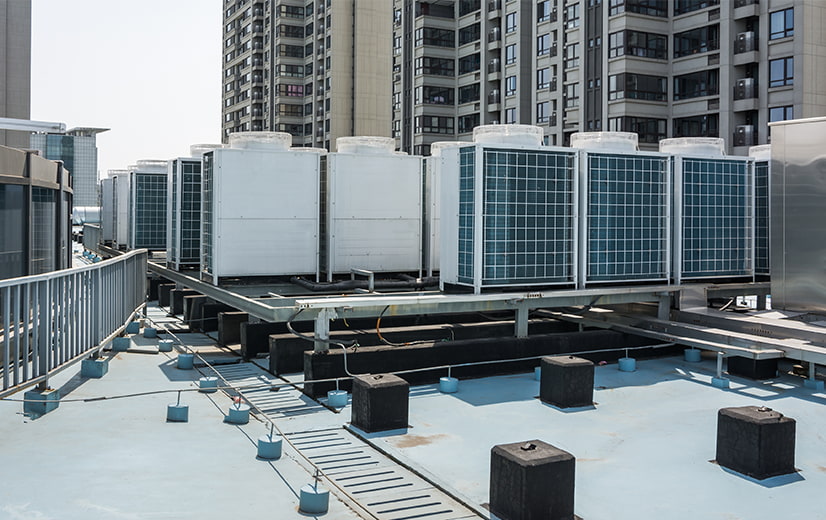
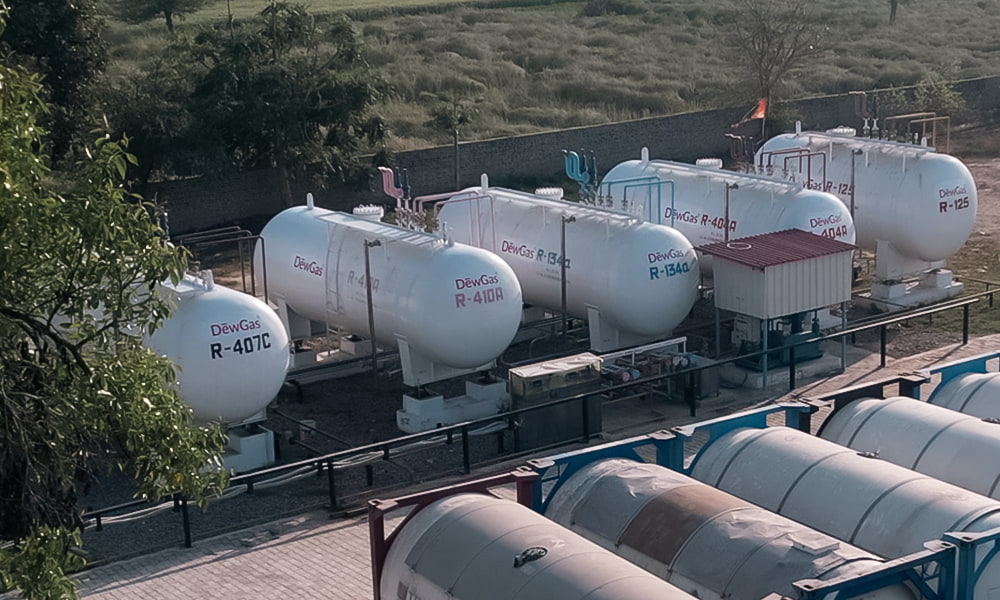
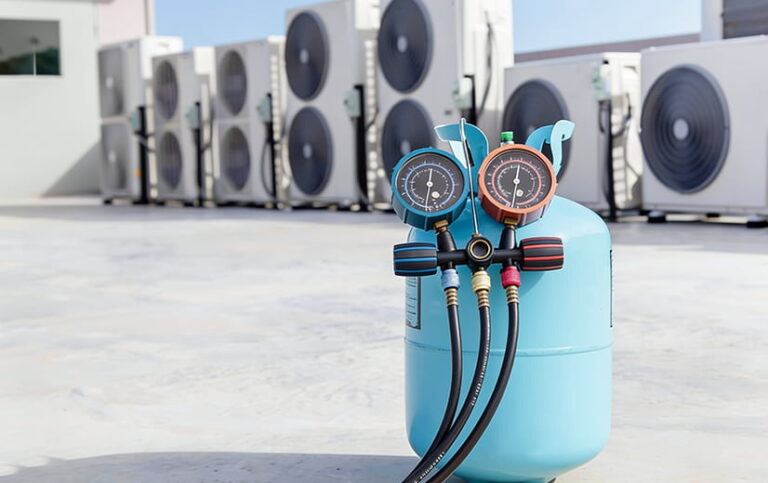
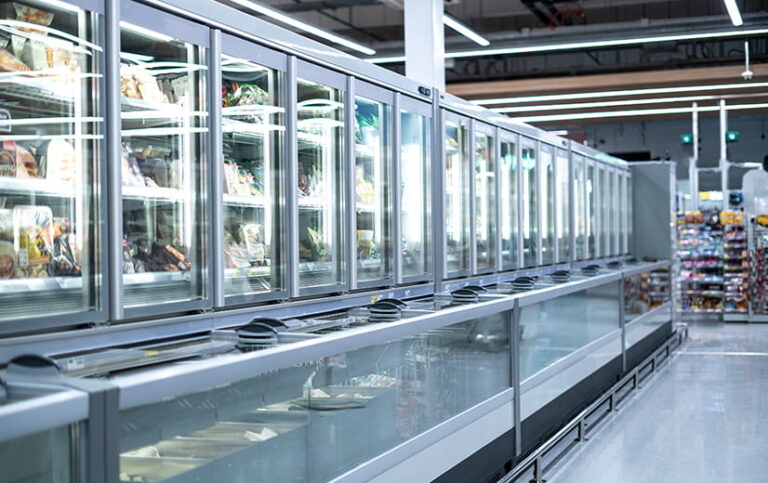
Every time an HVAC technician charges a system after a leak, every time a cold storage facility holds vaccine stock through a 45°C Indian summer, every time a data centre keeps its servers from throttling — a refrigerant gas is doing the work. Quietly. Reliably. Under pressure — literally.
Yet for most buyers, a cylinder of refrigerant is still a commodity: a generic product chosen on price and availability. That mindset is changing fast, and for good reason. As India’s refrigeration market grows toward USD 3.5 billion by 2034 (IMARC Group, 2025) and regulatory pressure mounts under the Kigali Amendment, the refrigerant you choose — and the quality you can verify — matters more than it ever has.
This guide explains how refrigerant gases actually work, what differentiates them, and why purity and traceability are no longer optional in a professional refrigeration system.
Key takeaways
Refrigerant gases cool spaces by cycling through four phases: evaporation, compression, condensation, and expansion — absorbing heat in one place and releasing it in another.
Different refrigerants suit different applications — from residential air conditioning to industrial refrigeration systems and transport cooling.
GWP (Global Warming Potential) and ODP (Ozone Depletion Potential) are now central to refrigerant selection as India’s phase-down schedule under the Kigali Amendment takes effect from 2028 onward.
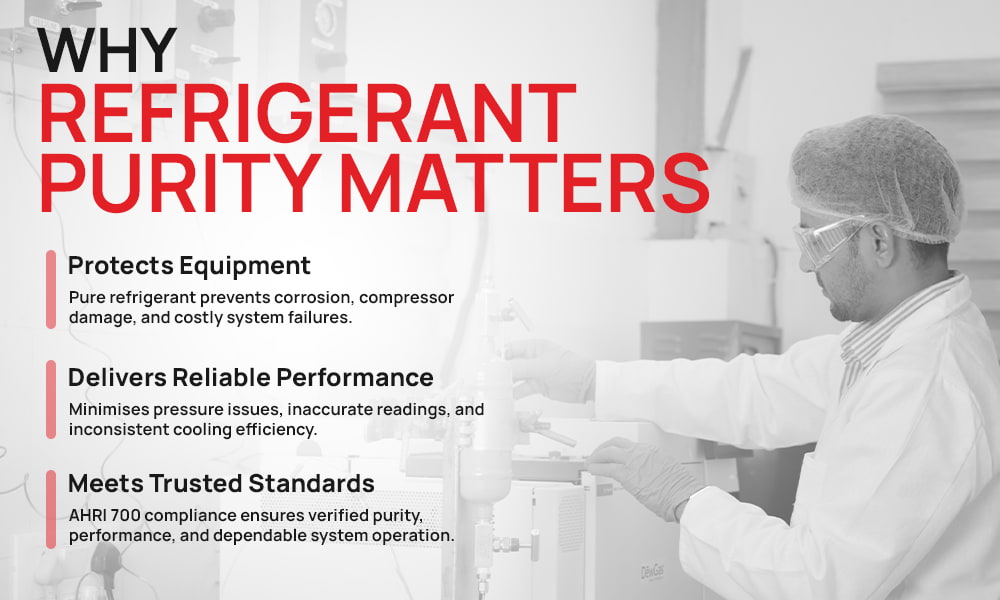
Purity matters: sub-standard or contaminated refrigerant causes compressor failures, poor cooling performance, and voided warranties.
AHRI 700 is the international benchmark for refrigerant purity — and the only objective way to verify what is in a cylinder before you charge a system.
How refrigerant gases actually work
Refrigerant gases work by exploiting a fundamental property of matter: when a liquid evaporates, it absorbs heat; when a vapour condenses, it releases heat. A refrigeration system is an engineered loop that moves this heat-transfer process where you need it.
Here is what happens inside a working refrigeration system:
1. Evaporation — where cooling happens. The refrigerant enters the evaporator as a low-pressure, low-temperature liquid. As it absorbs heat from the surrounding environment — a cold room, an AC unit’s indoor coil, a process fluid — it evaporates into a vapour. This is the stage that produces cooling: heat is pulled out of the space and into the refrigerant.
2. Compression — raising the stakes. The compressor draws in that low-pressure vapour and compresses it. This raises both the pressure and temperature of the refrigerant significantly. At this stage, the refrigerant is a hot, high-pressure gas.
3. Condensation — where heat is rejected. The hot vapour moves to the condenser (typically an outdoor coil in an air conditioning refrigeration system). Here, it releases its heat to the outside air or cooling medium and condenses back into a liquid.
4. Expansion — resetting the cycle. The high-pressure liquid passes through an expansion valve, where a sudden pressure drop sharply reduces its temperature. It enters the evaporator ready to absorb heat again, and the cycle repeats.
This is the vapour-compression refrigeration cycle — the engine behind every air conditioner, commercial cooling system, industrial refrigerator, and cold chain unit operating in India today.
The refrigerant is not consumed in this process. It cycles continuously. Which is exactly why its chemical stability, purity, and consistent composition directly determine how reliably and efficiently your entire system performs.
The main types of refrigerant gases — and where each is used
Not all refrigerants are interchangeable. Each has a distinct thermodynamic profile, safety classification, environmental footprint, and ideal application range. Here is a practical breakdown of the gases most commonly used across Indian commercial and industrial refrigeration.
R-22 (HCFC-22) — the legacy refrigerant being phased out
R-22 was the standard air conditioning refrigerant for most of the 20th century and remains in many older systems across India. It is an HCFC (hydrochlorofluorocarbon), which means it contains chlorine — giving it an ODP of 0.055 and a GWP of approximately 1,810.
Under the Montreal Protocol and India’s HCFC phase-out management plan, R-22 production and import are being wound down. Technicians still service legacy systems with R-22, but new equipment cannot be designed around it. The priority now is managing existing stock carefully — which makes batch-tested, QR-verified R-22 cylinders especially important during this transition period.
R-410A — high performance, high GWP
R-410A became the dominant replacement for R-22 in residential and light commercial air conditioning. It has zero ODP and significantly better energy efficiency than its predecessor. However, its GWP of 2,088 makes it one of the most potent HFCs in common use — every kilogram released has the warming effect of over two tonnes of CO₂.
As India’s HFC baseline freeze approaches in 2028, R-410A faces growing regulatory pressure. Many OEMs are already transitioning new equipment designs away from it.
R-32 — the transition refrigerant
R-32 is emerging as the preferred replacement for R-410A in residential and light commercial air conditioning applications. Its GWP is approximately 675 — roughly one-third that of R-410A — and its ODP is zero. It also requires a smaller charge mass than R-410A, which reduces system-level emissions risk.
R-32 carries an A2L safety classification (mildly flammable), which means handling and installation require care and appropriate training — but it is not in the same hazard category as A3 refrigerants like propane. For Indian conditions — high ambient temperatures, dense urban installations — R-32 offers a workable balance between environmental performance and practical handling.
R-134a — the transport and industrial workhorse
R-134a is widely used in transport refrigeration (refrigerated trucks, railway wagons) and some industrial refrigeration equipment. It has zero ODP and a GWP of 1,430 — lower than R-410A, but still classified as a high-GWP HFC. Like R-410A, it is under regulatory scrutiny globally and in India.
R-404A and R-507A — commercial cold chain standards
These HFC blends are commonly used in commercial cooling systems — supermarket display cases, cold storage rooms, and process cooling. They offer reliable low-temperature performance but carry high GWPs (R-404A at approximately 3,922). The commercial refrigeration sector is actively evaluating lower-GWP alternatives, including R-448A and R-449A blends, for retrofit applications.
Ammonia (R-717) and CO₂ (R-744) — natural refrigerants for industrial scale
For large-scale industrial refrigeration systems — food processing plants, breweries, pharmaceutical cold storage, ice rinks — ammonia remains the refrigerant of choice. Its GWP is zero, it is highly energy efficient, and its strong odour means leaks are immediately detectable. The trade-off is toxicity, which requires industrial-grade safety protocols and trained handling.
CO₂ is gaining ground in cascade systems and transcritical configurations, particularly where lower temperatures are required alongside a lower environmental impact.
Why refrigerant quality directly affects system performance
Here is a scenario that plays out more often than most technicians admit: a system is charged with a cylinder of unverified refrigerant, it underperforms from day one, and six months later the compressor fails. The fault is traced to moisture, non-condensable gases, or an off-spec refrigerant blend in the original cylinder.
Refrigerant purity is not an abstract specification. It has direct, measurable consequences.
Moisture contamination reacts with refrigerant oil to form acids, corroding compressor internals.
Non-condensable gases (air, nitrogen) increase head pressure, reduce efficiency, and mask leak detection readings.
Off-spec blends in mixed refrigerants can cause composition shift during charging, leading to inconsistent performance and incorrect superheat readings.
AHRI 700 is the internationally recognised standard for refrigerant purity. It specifies acceptable limits for moisture content, acidity, non-condensables, and other contaminants. Every cylinder that meets AHRI 700 specifies these parameters has been batch-tested against them — giving contractors and facility managers an objective, verifiable basis for quality assurance.
In a market where refrigerant is still frequently purchased on price alone, AHRI 700-compliant product is the minimum standard a professional buyer should insist on.
What QR traceability actually means for you
Beyond purity standards, the question of which specific batch a cylinder comes from matters. A quality certificate issued at a plant level does not tell you whether the cylinder in your hand came from that tested batch, or whether it was handled correctly between dispatch and delivery.
QR-based traceability solves this. When every cylinder is linked to its specific batch test record via a scannable QR code, you can verify purity, origin, and handling history at the point of use — before you charge a system. This is not a feature. It is the difference between a quality claim and a quality record.
No other refrigerant brand in India has built this end-to-end traceability system from batch test to delivered cylinder.
Industrial refrigeration systems: scale, complexity, and higher stakes
Industrial refrigeration systems operate at a scale where quality problems compound fast. A single large ammonia system may circulate hundreds of kilograms of refrigerant. A commercial cold chain network may run dozens of parallel refrigeration circuits across a distribution centre. At this scale, the consequences of sub-standard refrigerant — compressor failures, process temperature excursions, compliance violations — are measured in lakhs, not thousands.
India’s cold storage sector is growing rapidly. As of June 2025, the country has 8,815 cold storages with a combined capacity of over 402 lakh metric tonnes (NCCD, 2025). The pharmaceuticals, processed food, and e-commerce sectors are driving new investment. All of these applications depend on industrial refrigeration equipment that performs consistently under Indian operating conditions: high ambient temperatures, power fluctuations, and seasonal demand peaks.
For facility managers and procurement teams in these sectors, the questions are not only “which refrigerant?” but “how do I verify what I am buying?” and “how do I trace a quality issue back to its source?”
The Kigali Amendment and what it means for India’s refrigerant choices
India ratified the Kigali Amendment to the Montreal Protocol in September 2021. The Amendment mandates a phased reduction of HFCs — the dominant refrigerants in most commercial and industrial refrigeration systems today.
India’s specific phase-down schedule:
2028: HFC consumption baseline is frozen
2032: 10% reduction from baseline
2037: 20% reduction
2047: 85% reduction (full phase-down)
This timeline is long enough to allow planning, but short enough that procurement decisions being made today — particularly for new industrial refrigeration equipment with a 15 to 20-year service life — need to account for what refrigerant will still be available and AHRI 700-compliant in 2035 and beyond.
The practical guidance for professional buyers: understand the GWP of every refrigerant in any new system you commission or maintain, and look for lower-GWP, transition-ready alternatives where they are technically viable for your application. This is not compliance for its own sake — it is about avoiding stranded assets.
What to look for in an industrial gas supplier
Choosing the right refrigerant partner is not a price-per-kilogram decision. For professional buyers, the relevant questions are:
Purity verification. Does your partner test every batch? Can they provide a purity certificate per cylinder, tied to a batch number? AHRI 700-compliant testing should be the standard, not the exception.
QR traceability. Can you verify the origin and handling history of a cylinder before you use it? Scan the QR code on a cylinder and you should see the batch test data and supply chain history of that specific cylinder — not a general product page. Verify before you charge. That is what a genuine quality record looks like.
Supply reliability. Does your partner have the infrastructure to maintain consistent stock across seasons and geographies? For industrial cooling systems in remote locations or during peak summer demand, supply-secure infrastructure matters as much as product quality. Plants positioned in both North and South India — such as Hisar, Haryana and Sri City, Andhra Pradesh — are designed with exactly this supply reality in mind.
Application support. Does your partner understand refrigerant applications well enough to advise on refrigerant selection, transition planning, and handling requirements?
Regulatory alignment. Is your partner’s portfolio aligned with India’s Kigali phase-down trajectory? A credible refrigerant partner will guide you toward transition-ready choices — not sell high-GWP stock until it is regulated out.
Sixty years of gases expertise matters. DewGas is built on the industrial gas legacy of GOPL (Gupta Oxygen Private Limited) — a family-built business supplying gases India’s industries depend on since 1966. That heritage is not incidental. Quality as a non-negotiable, not a differentiator, is the founding instinct of this business.
FAQ
What is a refrigerant gas and how does it work? A refrigerant gas is a chemical compound that cycles through a refrigeration system, absorbing heat by evaporating at low pressure and releasing heat by condensing at high pressure. This continuous cycle moves heat from inside a space (or process) to outside it, producing the cooling effect.
What is the difference between commercial and industrial refrigeration? Commercial refrigeration typically refers to systems used in retail, food service, and light-duty cold storage — supermarket cases, restaurant coolers, and beverage chillers. Industrial refrigeration systems are larger-scale, higher-capacity systems used in food processing, cold chain logistics, chemical processing, and data centres. Industrial systems often use different refrigerants (such as ammonia) and require more complex safety protocols.
Which refrigerant gas is used in air conditioning? The most common air conditioning refrigerants in India are R-22 (in older systems), R-410A (in systems manufactured over the past decade), and increasingly R-32 (in newer equipment). R-32 has a significantly lower GWP than R-410A and is the direction most OEMs are moving for residential and light commercial AC.
What does AHRI 700 mean for refrigerant quality? AHRI 700 is an international standard published by the Air-Conditioning, Heating, and Refrigeration Institute. It sets purity specifications for refrigerants — including moisture, acidity, non-condensable gas content, and other contaminants. A refrigerant tested to AHRI 700 has been batch-tested and verified against these parameters. It is the most widely recognised benchmark for refrigerant quality in the HVAC and industrial refrigeration industry.
What is GWP and why does it matter when choosing a refrigerant? GWP stands for Global Warming Potential — a measure of how much heat a gas traps in the atmosphere relative to CO₂ over 100 years. A refrigerant with a GWP of 2,000 has 2,000 times the warming effect of CO₂ per kilogram if released. Under the Kigali Amendment, India is committed to phasing down high-GWP HFCs. Choosing lower-GWP, transition-ready refrigerants now reduces future compliance risk and extends the useful life of your refrigeration system.
How do I know if a refrigerant cylinder is genuine and uncontaminated? Look for a partner who provides batch-level purity certificates and QR-based traceability on every cylinder. Scanning the QR code should give you access to that batch’s test data and supply chain history — not a general product page. This is the only way to verify quality at the point of use rather than relying on verbal assurance alone.
Conclusion
Refrigerant gases are the working fluid of every cooling system — from the AC in a hospital ward to the cold room preserving a season’s worth of produce. How they work is elegant thermodynamics. How well they work depends entirely on purity, consistency, and fit for application.
India’s industrial and commercial refrigeration landscape is at an inflection point. Market demand is growing, regulatory requirements are tightening, and the cost of a compressor failure or a compliance violation is rising. In this environment, the refrigerant in your system is not a commodity decision — it is a quality decision.
The right refrigerant partner does not fill cylinders and walk away. They batch-test every product, make quality verifiable at the point of use, and help you navigate the refrigerant transition with clarity, not guesswork.
Genuine Refrigerants.
Ready to verify the quality of the refrigerant in your next project? Explore our AHRI 700-compliant refrigerant range or talk to our technical team about the right refrigerant for your application.